

HUAYI: Professional Earth Resistance Tester Manufacturer
Wuhan HUAYI Electric Power Technology Co.,Ltd. (HUAYI for short) is a professional manufacturer in China, researching and manufacturing electric testing equipment. HUAYI insist developing and marketing independently, and make efforts to improve the products quality, reduce cost, and improve efficiency.


Why Choose Us
Rich Experience
The company was established in 2005 and has more than ten years of professional experience. It is one of the earliest manufacturers of high-voltage testers in China.
Professional Technology Support
Specialize in testing and solutions for more than 18 years. Own experienced engineers. Professional on delivery, installation, debugging, and training.
ISO Certification
We have a professional R&D technical team and strict quality control to ensure safety, accuracy and efficiency. Passed ISO9001 certification and obtained relevant patent certificates.
24 hours After-sales
Professional after-sales service, paying attention to customers' feedback about products; Providing solutions within 24 hours, if the customers have any problem; Act quickly and efficiently.
Product Parameter
|
Working condition |
-15℃∽40℃ |
RH<80% |
|
Principle of anti-interference |
Frequency conversion method |
|
|
Power supply |
AC 220V±10% |
Allowable generator |
|
Measured output current |
1A~5A adjustable |
|
|
Measuring output voltage |
0V~420V |
|
|
Test power frequency |
5,50,55,60,65HZ |
Single frequency |
|
45/55,55/65 47.5/52.5HZ |
Automatic dual-frequency |
|
|
Rated output power |
2100W |
|
|
Resolution |
Impedance ground |
0.0001 |
|
Impedance angle |
0.0001° |
|
|
Accuracy |
Impedance ground |
±(1%*reading+0.002) |
|
Impedance angle |
±(1%*reading+0.02°) |
|
|
Resistance measuring range |
0.001Ω~5K |
|
|
Size |
370(L)×295(W)×358(H) |
|
|
Memory |
100 group support U disk |
|
|
Weight |
Host 22 Kg |
Earthing sticks 7 Kg |
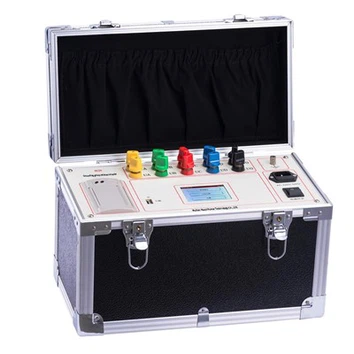
Construction of Earth Resistance Testers
Current Source
Generates a controlled current to be injected into the ground.
Voltage Measurement Circuit
Measures the potential difference between the ground electrodes.
Display Unit
Shows the ground resistance value in ohms or other relevant units.
Controls and Settings
Allow users to configure test parameters and select measurement modes.
Material of Earth Resistance Tester
Outer Casing Material
Made of durable ABS plastic or reinforced polycarbonate to provide insulation, impact resistance, and weather protection.
Electrodes
Constructed from stainless steel or copper-clad steel for high conductivity and corrosion resistance.
Circuit Components
Includes precision resistors, capacitors, and microprocessors for accurate resistance measurement and signal processing.

Accurate and Reliable Test Results: The tester provides accurate and reliable test results, effectively assessing the quality and safety performance of grounding systems.
Simple Operation of the Instrument: The operation of the testing instrument is straightforward, user-friendly, and does not require specialized skills.
Compact Size: The instrument has a small size, making it convenient to carry and use.
Affordable Price: The price of the instrument is relatively low, making it suitable for enterprises and organizations of various scales.
Application of Earth Resistance Tester
Household Appliances Testing: A earth resistance tester ensures that the ground resistance is within acceptable limits, confirming that the appliance is safe to use.
Lighting and Electronic Equipment Testing: A earth resistance tester verifies that these devices have a secure, low-resistance grounding system, reducing the risk of electrical faults or fire.
Industrial Equipment Testing: A earth resistance tester plays a vital role in ensuring the safety of this equipment, especially for high-power equipment that requires a robust grounding system to handle potential fault currents.
Medical Equipment Testing: A earth resistance tester helps confirm that these devices are properly grounded, reducing the risk of electrical hazards in medical environments.
The earth resistance tester is primarily used to measure the resistance of earthing systems. It assesses how well the ground connection operates, which is vital for protecting electrical systems and preventing electrical shock hazards. In contrast, a megger, short for megohmmeter, is designed to measure insulation resistance. It is an invaluable tool for ensuring that electrical installations are safe and reliable, preventing potential breakdowns or failures.

Usage Requirements
Safety Operations
Earth resistance testing involves high voltage and current, making strict adherence to relevant safety regulations and operating procedures essential.
Compliance with Safety Regulations
Before use, inspect the electrical connections of the tester, such as the power source and plugs, ensuring there are no issues such as burrs or fractures.
Appropriate Selection of Testing Conditions
Reasonable parameter selection enhances the accuracy and reliability of the test.
Prevention of High Voltage Breakdown
During testing, insulation between the tester's electrodes and the device to be tested is necessary to avoid high-voltage breakdown incidents.
Maintenance Attention
Regular maintenance and timely replacement of parts, along with circuit inspections, are necessary to extend the tester's lifespan.
Environmental Considerations
During usage, consider the environmental factors such as humidity, temperature, and atmospheric pollution, as these can impact the accuracy of test results.
How To Cooperate With Us
Inquiry: You can contact us online or sending us an inquiry. Please provide the details of your requirements as clear as possible. So we can send you the offer at the first time.
Phone Number: (+86)-18062012971/whatsapp:+8618064115448
E-mail: sales@sinohipot.com/ tina@sinohipot.com
Custom Plan Development: During the consultation, we’ll evaluate your specific requirements and together, craft a custom quality assurance plan tailored to your needs.
Agreement and Setup: Once you’re satisfied with the plan, we’ll finalize the details and set up everything needed to get started.
Quality Assurance Implementation: Our team will then implement the quality assurance protocols on your selected products or processes.
Delivery: Deliver cargos by sea or by air according to requirement.
Packaging and Delivery
|
Packing detail: |
Packing with wooden cases, provide different solutions of shipping way. |
|
Payment: |
We accept many payment term, such as T/T, Western Union, L/C. |
|
Warranty period: |
One-year warranty, Installation, and commissioning of specific products. |
|
Delivery time: |
Most of our products are in stock and can be delivered upon payment. The delivery time usually does not exceed 15 days. |

Our Certificates

As one of the most professional earth resistance tester manufacturers and suppliers in China, we're featured by quality products and competitive price. Please rest assured to buy cheap earth resistance tester made in China here from our factory.
digital earthing meter, 10A earthing continuity tester, digital ground resistance meter