

Medium voltage (MV) distribution cables-typically rated from 6 kV to 35 kV-form the backbone of urban and industrial power networks. Because these cables are buried, spliced, and operated for decades, insulation degradation is unavoidable. No single test reveals the full picture: an AC withstand proves strength, a dielectric-loss measurement reveals bulk aging, and a partial-discharge survey localizes discrete defects. The "Triple Diagnostic" approach combines all three to move from a simple pass/fail verdict to a genuine condition assessment.
The Triple Diagnostic principle: use each method for what it does best. VLF proves dielectric strength, Tan Delta quantifies bulk insulation quality, and Partial Discharge pinpoints the exact location and nature of a defect.
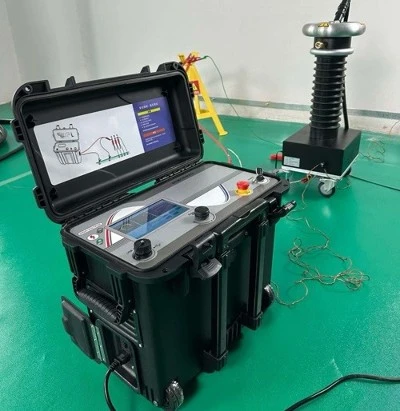
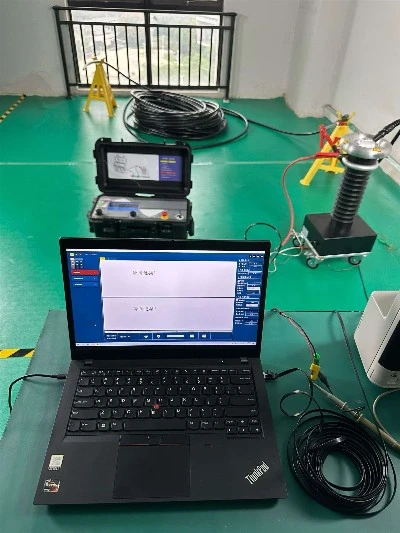
Very Low Frequency testing applies an AC sinusoidal voltage at 0.1 Hz (per IEEE 400.2) to stress the cable insulation for a defined hold period-commonly 15 to 60 minutes at 2–3 U₀. Compared with DC testing, VLF avoids the harmful space-charge accumulation that damages XLPE insulation; compared with 50/60 Hz, the low frequency keeps the reactive power demand and hardware size manageable in the field.
What it finds: Detects gross defects such as water trees, voids, and severe mechanical damage that have not yet progressed to failure.
Pass/Fail verdict: A pass confirms the cable can survive an over-voltage stress without breakdown; a failure identifies a cable already at end-of-life.
Standards: IEEE 400.2, IEC 60502, and most utility specifications mandate VLF AC as the commissioning and maintenance withstand test for MV XLPE cables.
VLF is a screening test. A "pass" does not mean the cable is defect-free-it only means the defects present did not grow to breakdown under the applied stress.
2. Tan Delta (Dissipation Factor) Diagnostics
Tan Delta-also called dissipation factor or dielectric loss-measures the ratio of resistive (loss) current to capacitive current in the insulation. A healthy, dry XLPE cable has an extremely low loss factor (typically well below 0.1%). Rising moisture, contamination, thermal aging, and water-tree growth all increase the loss and shift the curve. Because the measurement is comparative, its value lies in trending: absolute values vary by cable, but changes over time are highly diagnostic.
Sensitive to: Bulk moisture ingress and wet insulation-one of the leading causes of MV cable failure.
Also reveals: Thermal and chemical aging of the XLPE compound and contaminated accessories.
Method: Measured as a function of test voltage (tip-up) to separate good insulation from ionization losses, following IEEE 400.2 and IEC 60250 methodology.
A single Tan Delta reading is a snapshot; a stable trend line is a diagnosis. A rising tip-up curve often signals the onset of ionization long before a withstand test would fail.
3. Partial Discharge (PD) Testing
Partial discharge is a localized, incomplete breakdown that does not bridge the insulation between conductors. Left unchecked, PD erodes insulation from the inside until it becomes a full failure. PD testing-typically performed under a VLF or power-frequency source using the IEC 60270 method with phase-resolved (PRPD) analysis-detects, locates, and characterizes these weak points, often years before they cause an outage.
Defect types: Voids, delamination, protrusions, floating electrodes, and defective joints or terminations.
Diagnostic richness: Magnitude (pC), inception and extinction voltage, and PRPD pattern shape identify both the location and the physical nature of the defect.
Value: The most precise of the three tools-it points a repair crew to the exact splice or section that needs attention rather than condemning the whole circuit.
PD is the "early warning system" of cable diagnostics. It converts a vague suspicion of degradation into a specific, actionable repair target.
4. Triple Diagnostic Comparison Table
The three methods are complementary, not competing. The table below summarizes how each contributes to a complete MV cable condition assessment.
|
Test Method |
Primary Goal |
Key Outcome |
|
VLF Withstand Testing |
Verify dielectric strength under AC over-voltage |
Pass/fail on integrity; screens out gross defects and end-of-life cables |
|
Tan Delta (Dissipation Factor) |
Quantify bulk insulation quality and aging |
Trend-based condition index; flags moisture, water trees, and thermal aging |
|
Partial Discharge (PD) |
Detect and localize discrete insulation defects |
Pinpoints defect location, type, and severity for targeted repair |
Combined workflow: run VLF first to confirm strength, Tan Delta to grade overall insulation condition, then PD to locate and characterize any remaining defect. Together they deliver a complete, non-destructive verdict on MV cable health.