

Because almost every GIS insulation failure begins as a defect that is electrically visible long before it is audible, visible or dangerous. A loose particle, a metallic protrusion, a void in a spacer or a floating electrode all produce discharge activity at operating voltage. IEC 62271-203 therefore requires PD testing as part of the dielectric routine, and a commissioning record without a PD baseline is an unverifiable claim.
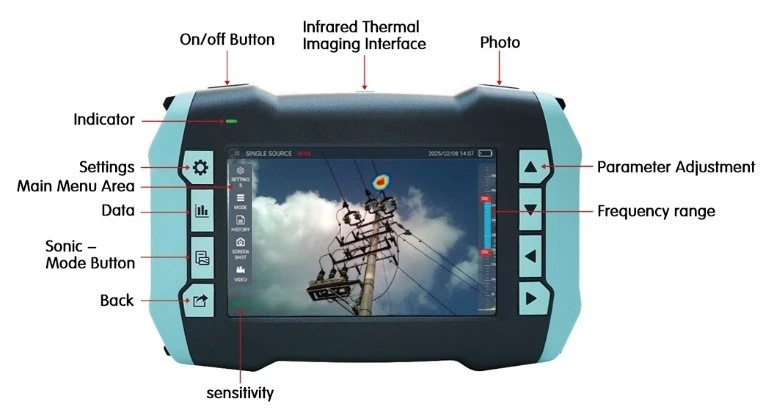
Partial Discharge UHF measurement is preferred for GIS because the tank is a natural waveguide. Sensors are mounted on or embedded in the basin insulators, which are non-metallic, and listen in the 300 MHz to 3 GHz range:
Immune to air corona - the acoustic and lower-frequency noise that ruins external measurements simply does not appear in the UHF band.
Locatable - time-of-arrival comparison across three or more sensors places the source within tens of centimetres inside the enclosure.
Pattern-recognisable - the PRPD phase-resolved pattern separates a free particle from a protrusion from a floating shield, which tells the crew what to open.
The measurement is repeated at raised voltage where the test set allows it, and the result is stored as a fingerprint: background level, peak amplitude and PRPD shape. That fingerprint is the only reliable reference for every later diagnostic. A bay with no PD record has no baseline, and a rise of a few dB three years later cannot be interpreted.