

Due to the complexity of battery electrochemical reaction, and different materials, structures, manufacturing processes, and service environmental conditions, the characteristics of batteries from different manufacturers vary significantly. Even batteries produced by the same manufacturer are discrete to a certain extent. Up to now, there is no simple and effective method in the world that can quickly and accurately determine the battery performance. Battery performance test and failure prediction is still a very complex problem in electrochemical measurement.
The state of stationary acid-proof and explosion-proof lead-acid batteries, which have been widely used in electric power, communication, finance, transportation, and other industries, can be learned by measuring the terminal voltage and checking the electrolyte density, liquid level, and temperature. However, the seal and barren liquor design of valve-regulated lead-acid (VRLA) batteries makes it difficult for us to learn about whether it is in a healthy status. Therefore, the test and maintenance means of acid-proof and explosion-proof batteries are no longer applicable to VRLA batteries, which is the shortcoming and difficulty of current battery operation management.
At present, the commonly used test method is to measure the battery terminal voltage at ordinary times and carry out the checking discharge capacity test every year. We think that
The terminal voltage of the battery under a floating charge has no correspondence with the capacity.
It is known that a battery of poor performance may be measured for the qualified voltage under a floating charge. So the terminal voltage under a floating charge cannot truly reflect the battery performance.
Full capacity discharge test is still the most accurate and effective method to test the actual capacity of the battery group.
It is known that the capacity of a battery group equals that of the worst-performing battery in the group. Therefore, the test of the battery group can be changed to the test of the delayed battery. The capacity of the battery group can be tested by detecting the delayed battery and measuring its capacity.
Discharge the battery group at a specified constant current and monitor the voltage of each battery. When the voltage of any of the batteries falls to the cut-off voltage, the capacity released is the actual capacity of the battery group. This method can test for the true and accurate results.
In the meantime, it is known that the battery has the following discharge curve:
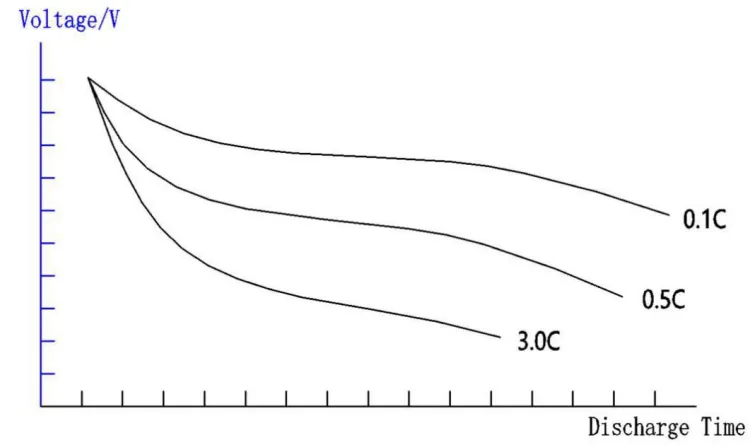
From the battery discharge curve, it can be seen that
The same discharge curve reflects the same battery performance. The characteristic curve of the same specification battery is the same for the same manufacturer, the same formula and the same production process (the discreteness in production is not considered temporarily).
The discharge curves of cells in the same group follow different discharge rates due to their different capacities. When the battery group is discharging, each cell has a different capacity but the same discharge current, so each is discharging at a different discharge rate. It is obvious that the discharge curves of different discharge rates are followed during discharging.