

The breakdown voltage of insulating oil is one of the most sensitive indicators of oil condition and of the internal health of a transformer. Because the test is simple, it is also easy to misread: a single low BDV value rarely identifies the root cause on its own. The five situations below cover the majority of inconsistent or unexpected BDV results reported from the field, together with the checks that confirm or exclude each cause.
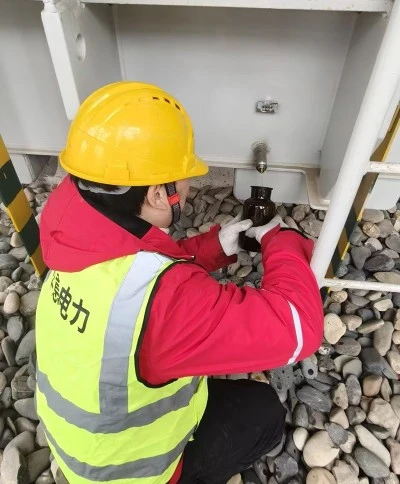
Why do repeated BDV tests on the same oil sample give different results?
Scatter between consecutive breakdowns is normal and is the reason IEC 60156 requires a defined number of breakdowns (typically six) with a rest interval between them, reporting the mean and the standard deviation. If the spread is unusually wide, the cause is almost always in the sample rather than in the oil: free water or solid particles suspended in the oil are statistically distributed, so each breakdown sees a different contaminant path.
Check the preparation chain first: the test cell must be rinsed with the sample itself, the electrodes must be polished and free of pitting, and the sample must not be poured from a container that has been shaken. A stable series (standard deviation below roughly 10 percent of the mean) indicates a homogeneous sample; a falling series, where each breakdown is lower than the last, indicates that carbon or water is accumulating in the gap.
The BDV is low but the oil looks clear. Is the problem moisture or particles?
Visual inspection is not a reliable indicator. Insulating oil can hold water in true solution and still appear bright and clear, yet the same water will separate as free droplets at the moment of dielectric stress. The decisive test is water content by Karl Fischer titration, which measures Dissolved Moisture and reports it in mg/kg (ppm).
Interpret the pair of results together. A low BDV combined with water above the IEC 60422 limits points to moisture ingress or a saturated breather; a low BDV with acceptable water content but visible sediment or a high particle count points to cellulose fibres, carbon or metal particles. Where water is the cause, the BDV usually recovers sharply after vacuum dehydration, whereas particle contamination requires filtration and, if carbon is present, an investigation into internal arcing or hot-spot activity.